Online enrichment can be free for an introductory session, priced per course, or billed weekly or monthly. A useful budget starts with the complete purchase, not a single advertised lesson price. Check the number and length of sessions, individual feedback, materials, software and renewal terms before comparing offers.
Below are published examples checked on October 28, 2026, followed by an original calculation worksheet. These examples are not a market average, a ranking or quotes for Vanguard Kids Academy. They describe different services and should not be treated as interchangeable. Prices and offers can change before checkout.
Published Price Examples: What the Amount Actually Buys
The table uses USD prices displayed on the providers’ own pages. A displayed promotional amount is a snapshot, not a guarantee that every course or session is available at that price.
| Provider and offer | Displayed price | Unit being sold | Important comparison limit |
|---|---|---|---|
| Create & Learn introductory class | $0 | An introductory live session | Not an entire free curriculum |
| Create & Learn group-class example | $94.50 | Four 55-minute sessions | Check the selected course, schedule and offer |
| Create & Learn private 1:1 example | $240 | Four 55-minute sessions | Individual instruction, unlike the group example |
| Oh!Nice SPACE teen makeup course | $15 | One selected self-paced course | Not four live meetings; supplies are a separate consideration |
Sources: Create & Learn pricing and Oh!Nice SPACE makeup courses. The makeup provider advertises ages 11-17; families should check the exact course’s suitability and requirements. The presence of a lower course price does not establish equal teaching time or support.
For Vanguard’s own coding, drawing and music options, review the current class details and confirm the total for the selected session. This guide does not turn a general site price range into a specific course quote.
First, Put Every Price in the Same Unit
A $20 lesson, a $90 course and a $40 monthly credit plan are not three versions of the same purchase. Write down exactly what each payment covers before deciding which is cheaper.
For a fixed course, calculate:
Tuition per scheduled lesson = course tuition / number of lessons.
If the session lengths differ, a second calculation helps:
Tuition per scheduled teaching hour = course tuition / total scheduled minutes x 60.
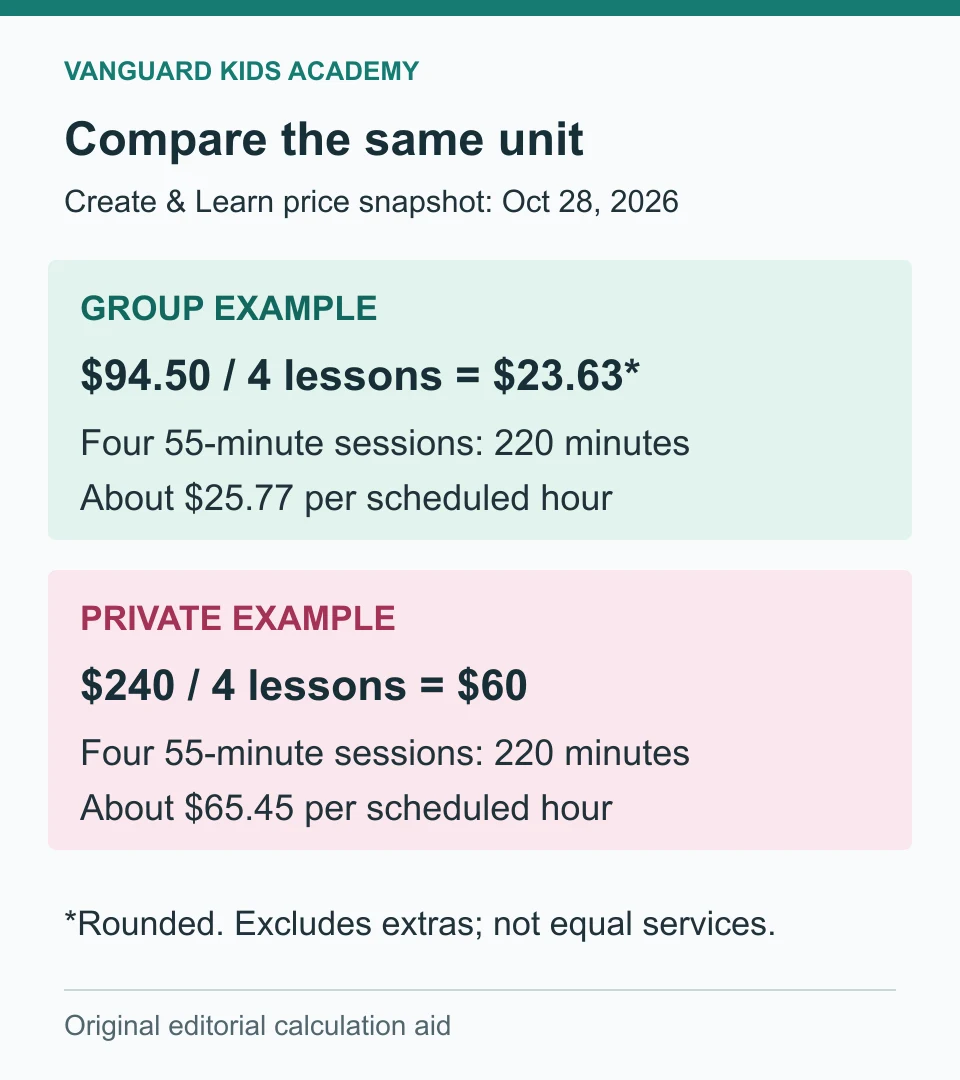
Using the published four-session examples above, $94.50 / 4 is approximately $23.63 per 55-minute group lesson. Four sessions contain 220 minutes, giving approximately $25.77 per scheduled hour. The $240 private example is $60 per 55-minute lesson, or approximately $65.45 per scheduled hour. These calculations exclude any other charges and do not measure learning quality. Keep the unrounded amount when calculating a course total rather than multiplying rounded lesson prices back up.
A self-paced course may not publish an equivalent amount of instructor time. Do not invent an hourly rate by assuming how long your child will take to finish. Instead, compare its access period, assignments, support and intended outcome. Our live vs self-paced comparison explains that distinction in more detail.
Build a Complete Budget, Not Just a Tuition Total
Use this formula for a defined period, such as a four-session course:
Expected cash cost = tuition + required materials + required software + applicable fees and taxes - confirmed discounts.
Only include a discount after you have checked eligibility and whether it applies to the selected purchase. Record optional purchases separately so they do not quietly become part of the required budget.
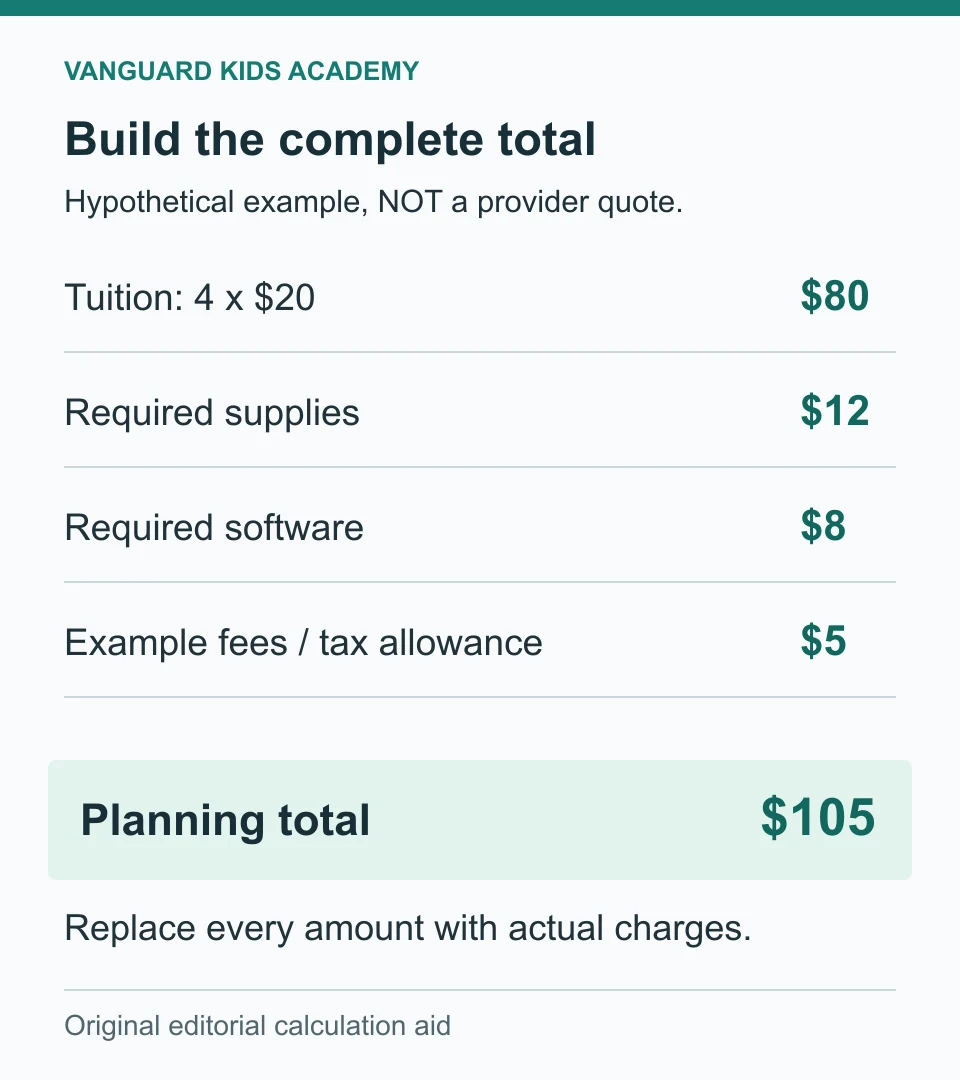
Here is a hypothetical planning example, not any provider’s quote: four lessons at $20 cost $80; add $12 of required supplies, an $8 software charge covering the course and a combined $5 allowance for applicable fees or taxes. That produces a $105 planning total. The $5 is an invented example amount, not a tax calculation or a claim that any platform charges it. Replace every amount with your actual checkout and supplies list.
Some purchases last beyond one course. If a drawing tool costs $30 and you expect to reuse it, show both the $30 you must pay now and any allocation you use when comparing courses. Allocating $10 to each of three future courses does not reduce today’s payment to $10. Reuse is also an expectation, not a guaranteed saving.
Time matters too, but keep it separate from money. Write down whether an adult needs to set up materials, troubleshoot software or supervise the activity. A lower cash price may still require more family time than you have available.
Weekly Billing Is Not the Same as a Monthly Price
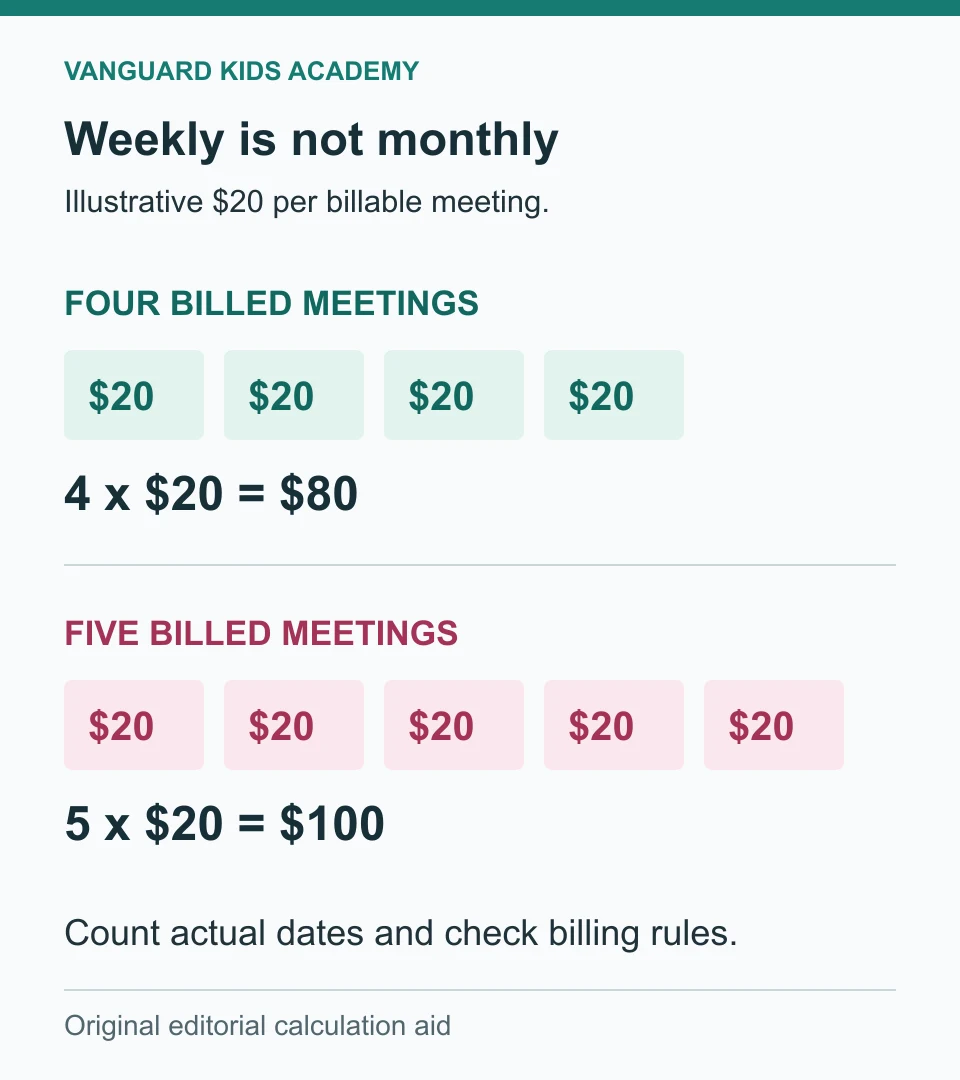
If an activity charges for each weekly meeting, count the dates that will actually be billed. At an illustrative $20 per meeting, four billable meetings cost $80 and five cost $100. This is not the same as a flat $80 monthly subscription. Holidays, course breaks and the provider’s billing rules can change the count.
Membership credits need a different check: what cash payment starts or renews the plan, how many credits the intended class consumes, and what happens to unused credits. Do not add a membership payment and the face value of the same included credits together; that would double-count one purchase. Equally, a credit balance does not mean another renewal cannot occur.
As a provider-specific example, Outschool’s membership guidance describes monthly renewals and included class credits. Its general payments guidance separately discusses marketplace fees and applicable taxes. The payment route matters: confirm the terms and final checkout for your own account rather than applying a fee from one route to every enrollment. No universal fee percentage is assumed here.
A Comparison Worksheet You Can Reuse
Copy these questions into your own notes for each shortlisted offer. Use the same period and number of children throughout the comparison.
| Item | What to record |
|---|---|
| Goal | What should the child be able to make, practice or explain? |
| Purchase unit | One lesson, a course, a recurring booking or a membership |
| Tuition | The actual price after an eligible, confirmed discount |
| Sessions | Number of meetings and minutes per meeting, if applicable |
| Required extras | Materials, equipment and software not already owned |
| Payment schedule | Amount due now and each later planned charge |
| Flexibility | Absence, cancellation, rescheduling and access rules |
| Support | Who reviews work, how often and through which channel |
| Decision | Fits the goal and total budget, needs clarification, or unsuitable |
If a listing omits an essential cost, mark it unknown and ask. A blank is not the same as $0. Likewise, an advertised “from” price is not a confirmed total for the class you want.
Questions to Ask Before Checkout
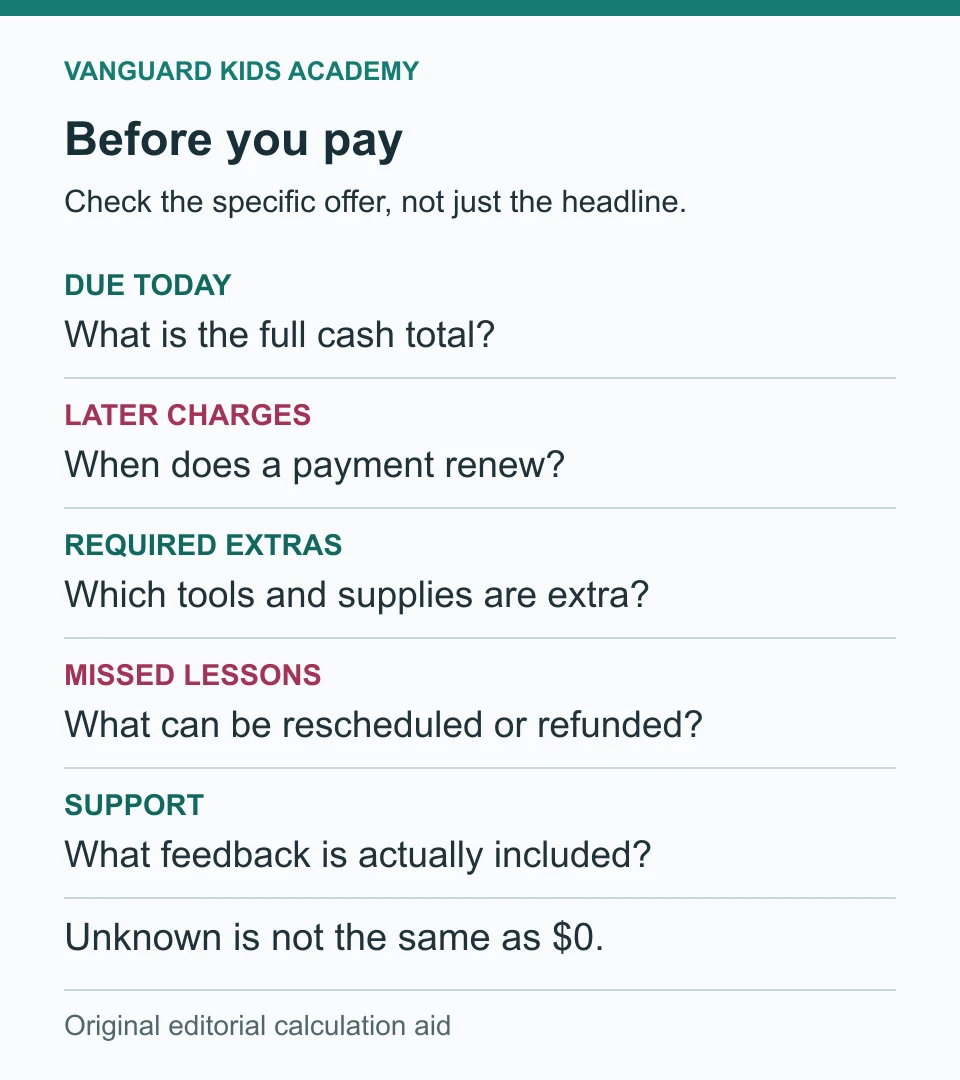
- What is due today, and what can be charged later? Look for recurring enrollment, automatic renewal and software trials that become paid subscriptions.
- Are materials and software required or optional? Ask for the list before buying. Confirm whether siblings can legitimately share equipment or whether each learner needs a separate seat or account.
- What happens if we miss a meeting? A recording, credit, makeup lesson and refund are different outcomes. Do not budget for a refund unless the actual terms provide one.
- What support is included? Find out whether work is reviewed individually, whether questions receive replies and whether the support period ends before lesson access does.
- Does the total fit this child’s goal? Check age, prerequisites, schedule and the child’s interest. A discount does not make an unsuitable course good value.
Ways to Reduce Cost Without Losing the Point of the Class
Start with an available sample or a short commitment when you are unsure of the subject. Check whether a sample represents the actual teaching format. A free introduction is useful for exploring, but it is not proof that a later paid course will fit your schedule.
Use materials you already own if the instructor confirms they are suitable. Ask about genuine sibling or group discounts, but check the per-child total and any minimum group size. Avoid buying a large credit package solely because its unit price is lower; compare it with the classes your family realistically plans to attend.
Compare feedback and opportunity to practice, not just minutes on a screen. A group and a private lesson can serve different needs. A recorded course can also be a reasonable choice when replayable demonstrations meet the goal and the required support is available. There is no single cheapest format for every child and subject.
Common Questions
What should I budget per month?
Build the figure from actual offers and billable dates. Count the learners, meetings, required extras and renewal charges you intend to purchase. The examples in this guide are not a recommended monthly spend or a market-wide price range.
Are private online lessons worth the extra cost?
They may fit a goal requiring individual pacing or feedback. Ask what the child receives that would be different in a group. A higher price alone does not establish quality, and a group may be preferable when interaction with peers is part of the goal.
Is a free class really free?
Check whether tuition is $0, whether materials or software cost extra, and whether enrollment starts a paid subscription. Do not assume that all introductory offers require a subscription, or that none do. Read the offer you are actually considering.
Should I compare courses by hourly price?
Use that calculation only when scheduled teaching time is known, and keep group size and support visible beside it. It is a unit comparison, not a learning-outcome score. It is usually inappropriate to invent an equivalent live-teaching rate for a prerecorded library.
Choose a Sustainable Total
A useful shortlist has a clear goal, a complete cash total and a payment schedule your family understands. If two offers fit those requirements, compare feedback and practical participation before deciding.
For the wider selection process, see how to choose an online class. For safe account and platform setup, use our online class safety guide.
Sources and Price Notes
Provider pages checked October 28, 2026: Create & Learn pricing, Oh!Nice SPACE makeup course, Outschool membership management and Outschool payments. This is a small illustrative selection, not an exhaustive survey. All four diagrams are original editorial aids; hypothetical budget amounts are explicitly labeled. Confirm current availability, eligibility and the full checkout total directly with each provider.